


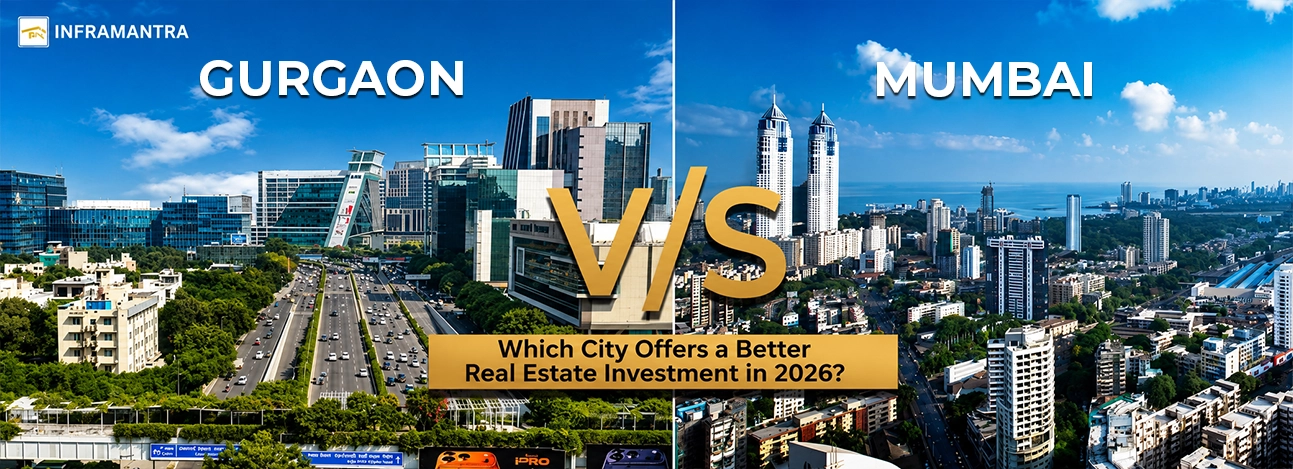
“Gurgaon outsold Mumbai in luxury housing for the first time on record in 2025, closing ₹24,120 crore in transactions above ₹10 crore against Mumbai’s ₹21,902 crore, according to data from India Sotheby’s International Realty and CRE Matrix. “
It is a milestone that would have sounded implausible 5 years ago. Whether you’re a homebuyer looking for the right city to live in or an investor looking for the right city to park capital in, the two questions you actually need answered are different — and this comparison answers both.
Mumbai: The Timeless Heavyweight That Never Really Steps Back
Mumbai’s advantage has never been about growth rate. It’s about scarcity. There is no city in India that matches Mumbai’s brand equity, financial gravitas, and lifestyle cachet, and land in South Mumbai, Bandra, and Worli simply doesn’t come easy. That scarcity is a structural, not speculative, driver of value — buying a sea-facing apartment in Worli means buying into decades of established demand and a social ecosystem few cities can replicate.
The city’s institutional pull backs this up: Cushman & Wakefield reported over $1.2 billion in institutional investment into Mumbai real estate in 2025, spread across residential, office, and logistics assets. Infrastructure is also reshaping the map — the Mumbai Trans-Harbour Link, Coastal Road, and metro expansions are opening up Thane, Navi Mumbai, and Panvel, with Navi Mumbai drawing fresh interest ahead of its upcoming international airport.
Rental yields sit in a steady 2.5%–4% band across most Mumbai localities, per Anarock Research, stretching toward the upper end in high-demand pockets like Worli and Chembur. NRI participation in Indian real estate has climbed from 7–10% of transactions in 2015–18 to an estimated 18–20% by 2025, with Mumbai consistently among the top two or three cities NRIs target. For an investor prioritizing an irreplaceable address and dependable long-term appreciation, Mumbai remains a legitimate, well-reasoned choice.
Gurgaon: The City That Rewrote the Rules
Gurgaon’s rise isn’t a one-year story — it’s a five-year compounding trend that reached a tipping point in 2025. Anarock’s NCR Real Estate report puts Gurgaon’s average residential price appreciation at 84% between Q1 2020 and Q1 2025, the second-highest of any NCR market. Zoom into individual corridors and the numbers get sharper: PropEquity data shows Southern Peripheral Road (SPR) prices moved from ₹7,693 per sq ft in 2020 to ₹17,123 per sq ft by end-2024, a roughly 125% gain in five years, while Dwarka Expressway posted 93% appreciation over the same period, per Anarock.
JLL’s Residential Dynamics Report placed Delhi-NCR — led by Gurgaon — at the top of all seven major Indian cities for 2025 annual price growth, at 13%, with a five-year CAGR above 11%, the highest nationally. The demand behind this is concentrated: HNIs, NRIs, and a fast-growing base of employees at multinational Global Capability Centres (GCCs) setting up in the city.
The Infrastructure Story Behind the Numbers
Gurgaon’s biggest structural advantage over the last three years has been infrastructure execution. The Dwarka Expressway is now a fully operational, signal-free corridor, and it has completely redrawn the city’s investment map — Sectors 102 through 115, once considered peripheral, are now among the most active micro-markets in the NCR. Transaction values on this corridor alone jumped 2,079% in a single year, from ₹383 crore in 2024 to ₹8,347 crore in 2025.
| Infrastructure | Gurgaon | Mumbai |
|---|---|---|
| Dwarka Expressway | ✅ Operational | ❌ |
| Metro Expansion | Ongoing | Ongoing |
| Expressways | Delhi-Mumbai Expressway | Coastal Road |
| Airport Connectivity | IGI Airport | Navi Mumbai Airport |
| Mega Development | Global City | Navi Mumbai |
The bigger story sitting behind that number is Global City — a ₹1.2 lakh crore, 1,000-acre city-within-a-city being developed by HSIIDC on Dwarka Expressway, modelled on Singapore and Dubai. Phase 1 trunk infrastructure is slated for completion by December 2026. Alongside it, a ₹5,452 crore metro expansion connecting Old and New Gurgaon is expected to cut travel time between the two zones by nearly 40%, and industry estimates point to 15–20% price appreciation along the corridor as these projects mature. The Delhi–Mumbai Expressway will add another layer of connectivity once complete.
The Business Hub Advantage: Where the Jobs Go, the Market Follows
What has driven Gurgaon’s residential market like nothing else is the sheer concentration of corporate presence – and more importantly, the corporate growth on the horizon.
DLF Cyber City, Udyog Vihar, and Sohna Road have long been established business zones. But two new commercial giants are taking shape now: Cyber City 2 on the Southern Peripheral Road, which already houses Tata Consultancy Services, American Express, and Genpact; and the aforementioned Global City on Dwarka Expressway, designed to house modern office campuses, high-street retail, and residences within a planned urban grid. When business follows infrastructure, housing demand is never far behind – and Gurgaon is a masterclass example of this sequence playing out at scale.
This is precisely why the rental opportunity in Gurgaon is so attractive right now. Young professionals, senior executives, and multinational employees need quality housing near their workplaces. New residential developments are being launched along these emerging corridors specifically to meet this demand. Anarock Research estimates Gurgaon’s residential rental yield at approximately 4.1% – the highest among all NCR markets and comfortably above Mumbai’s city-wide average – with select expressway-adjacent sectors delivering even stronger returns as corporate demand intensifies.
Space, Value, and the Price-Per-Square-Foot Gap
The difference becomes obvious the moment you compare what the same budget buys in each city. Altamount Road — India’s so-called Billionaire Row — averages around ₹98,200 per sq ft according to 99acres transaction data, with select projects crossing ₹1,00,000 per sq ft per Sobha’s South Mumbai market report. On Golf Course Road in Gurgaon, premium apartments average ₹27,000–₹30,000 per sq ft as of 2025–26, with ultra-luxury outliers like DLF Camellias commanding ₹35,000-plus. A budget that buys a compact 2BHK in Bandra West can buy a spacious 3BHK or 4BHK with a clubhouse, landscaped greens, and a private lift lobby along Golf Course Extension Road or SPR.
That price-to-value gap shows up directly in sales volume: the number of high-end homes sold in Gurgaon nearly tripled year-on-year in 2025, from 519 units in 2024 to 1,494 units, at an average ticket size of roughly ₹16 crore. The average size of these homes was close to 5,000 sq ft, with the 4,000–6,000 sq ft segment dominating demand — space that simply isn’t available at that ticket size anywhere in well-located Mumbai.
For the Homebuyer: Space, Lifestyle, and What You Actually Get to Live In
If you’re buying to live in it, the decision usually comes down to space, commute, and community — not just price appreciation. Gurgaon’s advantage here is straightforward: the same budget that buys a compact 2BHK in Bandra West buys a spacious 3BHK or 4BHK with a clubhouse, landscaped greens, and a private lift lobby along Golf Course Extension Road or SPR. With Dwarka Expressway now signal-free and the metro link between Old and New Gurgaon cutting cross-city travel time by nearly 40% once complete, commute concerns that used to rule out these newer sectors are fading fast.
“Looking to invest in Gurgaon? Explore premium residential properties in Gurgaon, Dwarka Expressway, Golf Course Road, SPR, and New Gurgaon with expert guidance from Inframantra.”
Mumbai still wins on one thing a spreadsheet can’t capture: proximity to an established social and professional ecosystem decades in the making. If your work, family, and lifestyle are already anchored in South Mumbai, Bandra, or Worli, no amount of extra square footage in Gurgaon changes that calculus. But for a buyer without that anchor, Gurgaon’s price-to-income ratio of 11.31 versus Mumbai’s 32.82 (Numbeo) means homeownership is a realistic near-term goal rather than a decade-long stretch
For the Investor: Yield, Appreciation, and Exit Potential
If you’re buying for returns, the comparison tilts more decisively. Gurgaon delivered 13% annual price growth in 2025 against Mumbai’s more modest, established-market pace, and a five-year CAGR above 11% — the highest of any major Indian city, per JLL. Layer in Gurgaon’s 4.1% average rental yield, the highest in the NCR and ahead of Mumbai’s 2.5%–4% band (Anarock Research), and the case for cash-flow-plus-appreciation is hard to ignore.
The corridors doing the heavy lifting — SPR (up ~125% since 2020) and Dwarka Expressway (up 93%, with transaction values up 2,079% in 2025 alone) — are also the ones with the most infrastructure still to be delivered. Global City’s Phase 1 completion by December 2026 and the continuing metro rollout suggest this appreciation curve isn’t done. For an investor, that’s the difference between buying into a market that has already priced in its growth (Mumbai, largely) and one where a meaningful part of the re-rating is still ahead (Gurgaon).
Mumbai isn’t without an investment case — $1.2 billion in institutional investment in 2025 (Cushman & Wakefield) and consistent NRI demand mean it remains a lower-volatility, capital-preservation play. It’s simply a different risk-return profile: Mumbai for stability and scarcity value, Gurgaon for growth and yield.
Thinking about investing in Gurgaon’s high-growth corridors? Talk to an Inframantra Relationship Manager for a free, no-obligation walkthrough of the right project for your budget and goals..
Frequently Asked Questions
Is Gurgaon really a better real estate investment than Mumbai in 2026?
For capital appreciation and space-per-rupee, Gurgaon currently has the edge — it posted higher annual price growth (13% in 2025) and a higher five-year CAGR (11%+) than Mumbai, per JLL. Mumbai still leads on legacy value, scarcity-driven pricing, and long-term stability.
Should a first-time homebuyer choose Gurgaon or Mumbai?
For buyers without an existing anchor in Mumbai, Gurgaon offers considerably more space and a far more manageable price-to-income ratio (11.31 versus Mumbai’s 32.82, per Numbeo), making homeownership achievable sooner rather than a decade-long stretch.
Which Gurgaon corridors have seen the highest price appreciation?
Southern Peripheral Road (SPR) and Dwarka Expressway have led the market, with SPR prices up roughly 125% and Dwarka Expressway up 93% between 2020 and 2024, according to PropEquity and Anarock data.
What is driving Gurgaon’s luxury housing boom?
A combination of completed infrastructure (the signal-free Dwarka Expressway, upcoming Global City, and metro expansion), rising GCC and MNC employment, and strong HNI and NRI demand for larger homes at a lower price-per-square-foot than Mumbai.
How do rental yields compare between Gurgaon and Mumbai?
Gurgaon offers the highest residential rental yield in the NCR at approximately 4.1%, per Anarock Research, ahead of Mumbai’s citywide average of 2.5%–4%.
You may also like to read:-
Is Golf Course Road the Pali Hill of Gurgaon?
Gurgaon’s Luxury Home Sales Jump 80% to Rs 24,120 Crore, Surpass Mumbai in 2025

✍️ Written By: Alka